



2026.11.19
How Many Ultherapy Shots Do You Need?
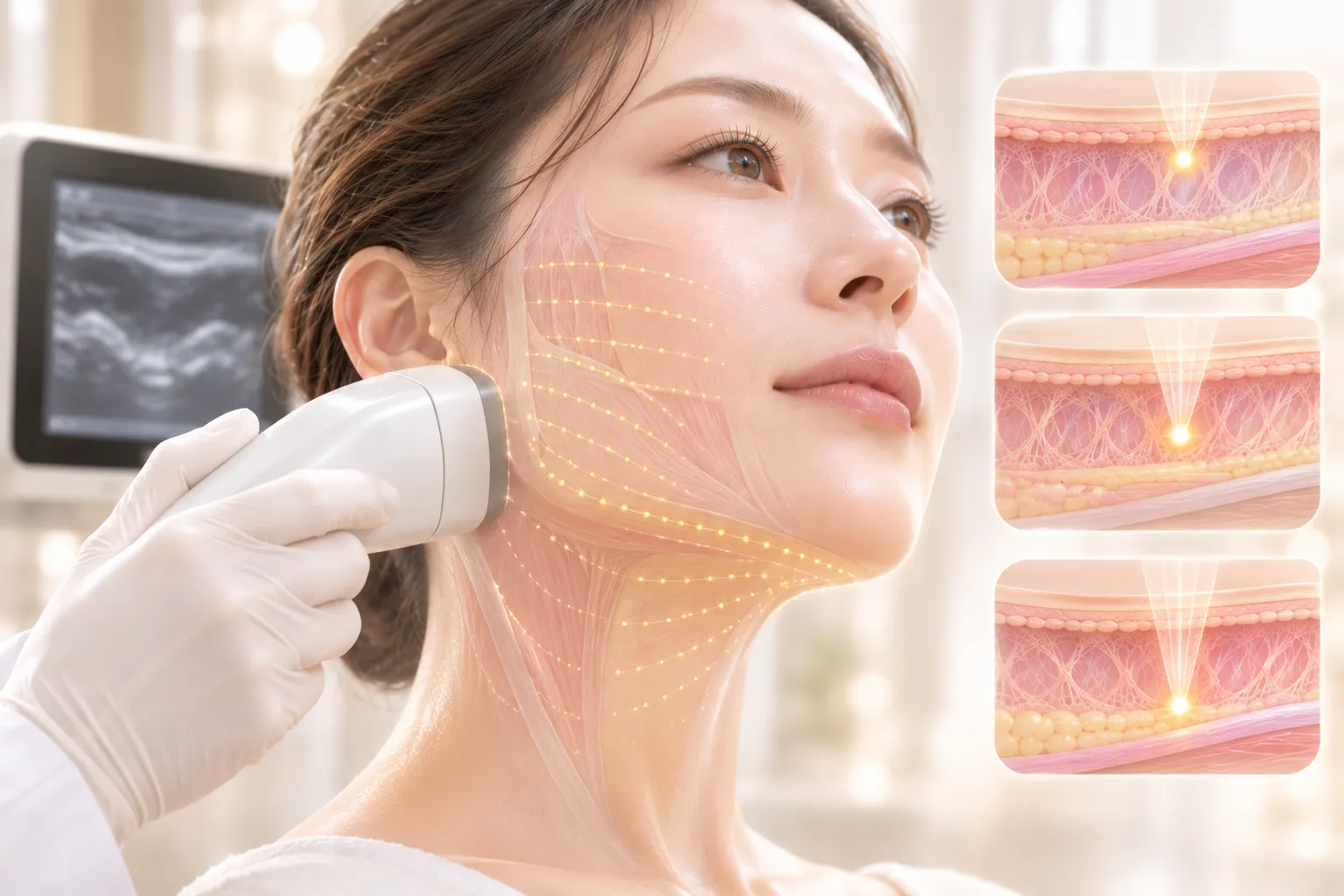
Determining the appropriate number of Ultherapy shots requires evaluating your unique facial structure, tissue depth, and personal aesthetic objectives. Rather than following a generic package, an effective ultrasound treatment plan relies on anatomical precision, proper energy distribution, and tailored clinical guidance.
Understanding Ultherapy Shots: What They Mean for Your Treatment
In micro-focused ultrasound therapy, the term “shot” refers to a specific delivery of energy designed to stimulate collagen production within precise tissue layers.
What Is a “Shot” in Micro-Focused Ultrasound?
A single shot delivers a linear sequence of thermal coagulation points (TCPs) beneath the skin without disrupting the epidermis. Each line consists of focused acoustic energy that heats targeted micro-zones to approximately 60 to 70 degrees Celsius. This controlled thermal exposure triggers an immediate contraction of existing collagen fibers and initiates neocollagenesis, the body’s gradual collagen-building response.
How Cartridge Depths (1.5mm, 3.0mm, and 4.5mm) Guide Shot Placement
Ultherapy utilizes specialized transducers that focus energy at predetermined depths, allowing physicians to address multiple tissue planes:
- 4.5mm Transducer: Focuses energy on the superficial muscular aponeurotic system (SMAS) layer and deep supportive tissues, typically across the cheeks, submental region, and upper neck.
- 3.0mm Transducer: Targets the deep dermis and superficial subcutaneous boundaries to address skin laxity and structural firmness.
- 1.5mm Transducer: Treats the superficial papillary and reticular dermis, commonly utilized for fine surface texture, delicate skin around the mouth, and select periorbital regions.
Typical Shot Count Ranges by Treatment Area
Treatment scope varies significantly based on whether a single concern or comprehensive structural tightening is addressed across the facial landscape.
Full Face (Including Under the Chin): Mild to Moderate Sagging
At our clinic, full-face treatment including under the chin is offered as a 348-shot plan for mild sagging and a 464-shot plan for moderate sagging. The doctor chooses the cartridges, and our clinic’s doctor treatment uses the 3.0 mm and 4.5 mm cartridges to address the SMAS layer and the firmness of the skin.
Full Face (Including Under the Chin): More Advanced Sagging
For more advanced sagging, a 760-shot full-face plan is offered. The plan is chosen after the doctor examines your face and the degree of sagging.
Face and Neck
Plans that include the neck are offered at 764 shots and 1,060 shots. Allocating sufficient density across both the face and neck is intended to help create smooth transitions and balanced results.
Delicate Zones: Forehead and Periorbital Regions
Shots can also be added to a plan; at our clinic, additional shots are available in units of 90. Because the soft tissue over the frontal bone and orbital rim is relatively thin, the doctor chooses the cartridge and energy carefully in these areas.
Factors That Influence Your Recommended Shot Count
A clinical assessment accounts for individualized anatomical variables rather than relying solely on predetermined line counts.
Degree of Skin Laxity and Tissue Thickness
Patients presenting with pronounced tissue descent or thicker subcutaneous fat layers may require a higher density of energy delivery to achieve adequate thermal coagulation across multiple planes. Conversely, thinner skin profiles necessitate calibrated shot distribution to prevent excessive thermal buildup in superficial compartments.
Facial Bone Structure and Volume Distribution
Craniofacial contours dictate how ultrasound energy is absorbed and reflected. Prominent zygomatic arches or shallow mandibular angles require careful transducer orientation to maintain continuous acoustic coupling and avoid firing over bony prominences.
Real-Time Ultrasound Visualization (DeepSEE Technology)
Ultherapy incorporates real-time ultrasound imaging, allowing practitioners to visualize tissue architecture beneath the surface. This capability ensures that each line is placed directly within the intended anatomical boundary, such as the SMAS or deep dermis, while actively avoiding bone or major blood vessels.
Common Misconceptions: Is a Higher Shot Count Always Better?
A common assumption is that maximizing the total shot count directly correlates with superior lifting, but anatomical suitability remains the governing factor.
Why More Shots Do Not Automatically Mean Greater Results
More shots do not automatically mean a better result. The right number depends on the area treated, the degree of sagging and your tissue, which the doctor assesses at your consultation.
Balancing Energy Output Levels with Shot Density
Ultherapy devices allow the energy level to be adjusted. The doctor sets the energy and the shot density according to your tissue and your comfort.
Risks of Improper Shot Placement and Overtreatment
Excessive thermal accumulation or inaccurate focal depth selection can lead to prolonged erythema, localized edema, or unintended atrophy of subcutaneous fat pads. Precise vector mapping ensures that structural volume is preserved where fullness is desired.
Clinical Considerations: Procedure Flow and Aftercare
Understanding the procedural experience, physiological response timeline, and safety guidelines assists in planning your treatment pathway.
Expected Sensations and Comfort Management Options
Patients typically perceive transient prickling, heat, or deep structural aching as acoustic pulses reach targeted layers. Comfort management strategies vary among medical facilities, ranging from topical anesthetics and oral analgesics to mild inhalation agents such as nitrous oxide, which provides rapid relaxation while allowing the patient to remain fully conscious.
Timeline of Results and Recommended Treatment Intervals
Initial tissue tightening may be felt right after treatment, and collagen is regenerated over about two to three months. At our clinic, the lifting effect is expected to last about six months to a year, and a session roughly every six months is a guide for those who wish to maintain it (results vary by individual).
Potential Side Effects and Safety Guidelines
Standard post-procedure responses include redness, mild swelling, tenderness to the touch and temporary tingling. Rarely, bruise-like tenderness, temporary changes in sensation (such as transient numbness) or slight bruising may occur. Redness usually settles within hours to a few days, and other symptoms within days to a few weeks. Adhering to verified medical protocols and receiving treatment from trained medical personnel helps reduce the risk of superficial welts or localized bruising.
Key Questions to Ask During Your Medical Consultation
A structured consultation allows you to evaluate whether a proposed treatment plan reflects your anatomical requirements and expectations.
Clarifying Shot Distribution Across Targeted Layers
Inquire how the recommended total shot count will be divided between transducer depths (4.5mm, 3.0mm, and 1.5mm) and specific facial vectors. Clarifying layer distribution confirms whether the procedure addresses deep structural support, dermal firming, or superficial texture.
Assessing Total Scope and Individual Suitability
Verify whether the plan covers full submental passes, isolated lower face areas, or multi-vector combinations. Ensure the practitioner explains their clinical rationale for the recommended count based on your specific tissue characteristics rather than a standard package.
Frequently Asked Questions About Ultherapy Shot Counts
Is a smaller number of shots enough? The right number depends on the area and your degree of sagging. At our clinic, the full-face plans start at 348 shots, and the doctor recommends a plan after examining you. More shots do not necessarily mean a better result.
Why do recommendations for the same treatment area differ between clinics? Variations arise from practitioner technique, vector planning, and whether sub-regions like the submental zone are categorized separately. A thorough consultation helps clarify the exact anatomical mapping included in each proposed plan.
Does combining Ultherapy with other procedures change the required shot count? Ultherapy can be combined on the same day with other treatments that work at different layers, such as Thermage FLX or Sofwave. The doctor assesses your tissue and decides the plan and the shot count.
Ultherapy is not approved under Japan’s Pharmaceuticals and Medical Devices Act. Our clinic imports the device, which is approved by the U.S. FDA, through the authorized domestic distributor under the doctor’s judgment. For more on personally imported medical devices, please see the Ministry of Health, Labour and Welfare website.
Medical Supervisor

Director
MOENO OKAWARA
Biography
- 2018
- Graduated from Kyorin University School of Medicine
- 2018
- Experienced dermatology, anesthesiology, and plastic surgery at Tokyo Women’s Medical University Hospital.
- 2020
- After joining a major beauty clinic, she gained a lot of experience in laser treatments, Botox injections, hyaluronic acid injections, as well as surgery such as sutures, under-eye bags, and thread lifts.
- 2023
- Former skin director of a major beauty clinic
- 2023
- Joined MATSURIKA CLINIC GINZA
Affiliated academic societies
- Japan Society of Aesthetic Plastic Surgery, Japan Society of Anti-Aging Medicine, Japan Society for Laser Medicine, Japan Society for Medical Hair Removal
- Allergan prescription certified doctor
- Juvederm Vista Certified Doctor
- Juvederm Vistabolift XC Certified Doctor
- Juvederm Vista Voluma XC Certified Doctor
- Juvederm Vistarolite XC Certified Doctor
- Ulthera certified doctor
- Thermage certified doctor
