


2026.10.17
Non-Surgical Facelift in Tokyo: Options, Expectations and Limitations
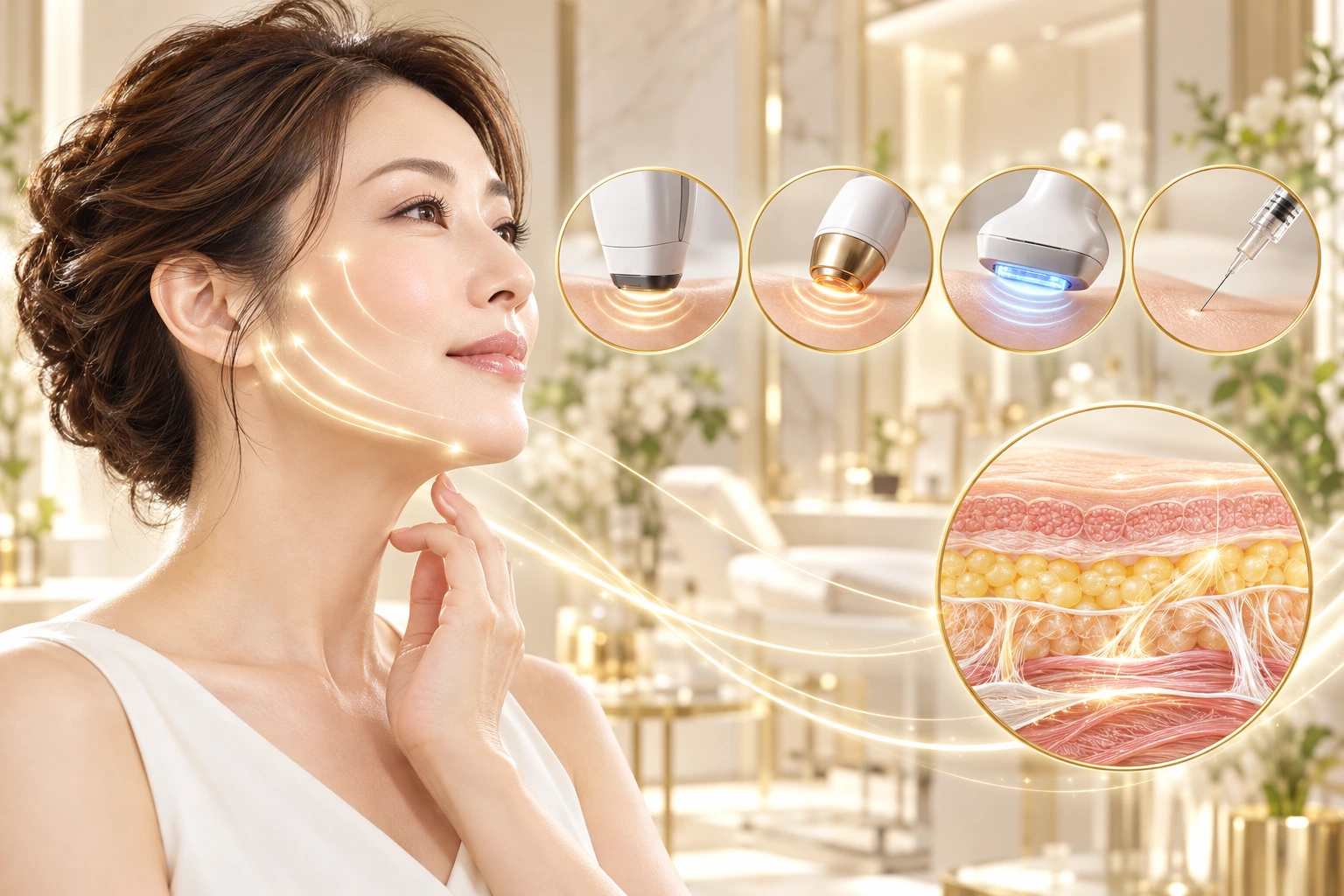
“Non-surgical facelift” is a popular term, but it does not describe one specific procedure. Clinics use it for a range of treatments, from ultrasound and radiofrequency devices to injectable treatments, all performed without surgical incisions.
Non-surgical treatments can improve skin firmness and some contour concerns, but they do not produce the same degree of change as a surgical facelift. They are generally considered for mild to moderate sagging, and the change develops gradually. When sagging is more pronounced, surgery may better match your goal.
This guide explains what a non-surgical facelift can mean, which options to discuss at MATSURIKA CLINIC GINZA in Tokyo, what changes and limitations to expect, and how to compare recovery, risks and total cost.
What Does “Non-Surgical Facelift” Mean?
The term usually refers to treatments that aim to firm the skin or improve facial contour without incisions. Because different treatments share the same label, it helps to understand what each one actually does.
Different Treatments Described With the Same Term
Treatments described as a non-surgical facelift often fall into these groups:
- Energy-based treatments: devices that use focused ultrasound, other ultrasound technologies or radiofrequency (RF) to heat tissue and stimulate collagen remodeling.
- Injectable treatments: fillers that restore volume in specific areas, or injections that target localized fat.
- Minimally invasive procedures: procedures such as thread lifts, which involve inserting materials beneath the skin.
These approaches work on different tissues and are not interchangeable. When a clinic recommends a “non-surgical facelift,” ask which treatment it means.
Clarifying Your Main Concern Before Choosing a Procedure
Your main concern determines which approach is worth discussing. Before your consultation, consider whether you are mainly concerned about:
- Skin that looks less firm, crepey or finely lined
- A softer jawline, jowls or heaviness in the lower face
- Hollowness or loss of volume in the cheeks or temples
- Fullness under the chin
- Significant loose skin on the face or neck
Many people have more than one concern. Ranking them helps your physician build a plan around what matters most to you.
Non-Surgical Options to Discuss in Tokyo
At MATSURIKA CLINIC GINZA, we offer several non-surgical options for sagging skin. Our physicians examine your face as a whole and explain why one option may fit you better than another.
Energy-Based Skin Tightening Treatments
| Treatment | Energy source | Main target | Treatment purpose |
|---|---|---|---|
| Ultherapy PRIME | Focused ultrasound (HIFU) with real-time ultrasound imaging | Deeper tissues, including the SMAS, at selected depths | Lifting-oriented concerns such as jawline and lower-face contour |
| Thermage FLX | Monopolar radiofrequency (RF) | Dermis and the tissue beneath it | Overall skin firmness and tightening |
| Sofwave | SUPERB™ ultrasound (parallel beams) | Dermis, centered at about 1.5 mm | Skin firmness, fine lines and wrinkles |
| ULTRAcel Zi | Focused ultrasound (HIFU) with dot and linear modes | Different layers depending on the mode | Sagging and localized fullness, depending on the mode |
The table shows differences in approach, not a ranking. Ultherapy PRIME is performed by a physician, who considers where to treat, which depths to target and how to distribute the shots. Thermage FLX and Sofwave are available as physician-performed or nurse-performed plans at different fees. For nurse-performed plans, a physician examines you first and decides the treatment area, and a nurse then performs the treatment. Combining treatments that work on different layers may be discussed when your concerns involve several layers.
Regulatory information: Ultherapy PRIME and Thermage FLX are FDA-cleared in the United States for their respective cleared uses. FDA clearance does not mean that every treatment purpose has been cleared and does not constitute approval in Japan. The Ultherapy PRIME, Thermage FLX and ULTRAcel Zi devices used at our clinic have not been approved under Japan’s Pharmaceuticals and Medical Devices Act. Ultherapy PRIME is obtained through Cynosure Japan / Syneron Candela K.K., Thermage FLX through JMEC Co., Ltd., and ULTRAcel Zi through Jeisys Medical Japan, Inc. ULTRAcel Zi is approved by the Ministry of Food and Drug Safety in South Korea. Sofwave is approved in Japan for improving moderate to severe wrinkles of the face and neck by heating the dermis; this approval does not cover every lifting purpose or guarantee results.
Other Approaches Your Doctor May Discuss
Energy-based devices do not address every cause of sagging. Your physician may also discuss:
- Hyaluronic acid fillers: for areas where loss of volume contributes to the appearance of sagging. The product, amount and injection site depend on the area.
- FatX Core: a fat-dissolving injection that may be discussed when localized fat, such as under the chin, is a main concern.
We explain the purpose, potential risks and costs of each option before you decide.
Understanding Expected Changes and Limitations
Setting realistic expectations is one of the most important parts of choosing a non-surgical option.
How Non-Surgical Goals Differ From Surgical Goals
A surgical facelift repositions deeper tissues and removes excess skin. Non-surgical treatments do not remove skin. Instead, energy-based treatments heat tissue to encourage collagen remodeling, and injectables change volume in specific areas.
As a result, non-surgical changes are usually more modest and develop gradually over the following months. The degree and duration of change vary from patient to patient, and maintenance treatment may be discussed as your skin continues to age. Non-surgical treatment also involves less recovery time and no surgical incisions, which is why many people consider it for mild to moderate sagging.
When a Different Approach May Better Match Your Concern
A non-surgical option may not match your goal when:
- Sagging is pronounced, with significant excess skin on the face or neck
- You hope for a change similar to surgery
- Your cheeks are already hollow in the area where Ultherapy PRIME or Sofwave would be applied
In these cases, we explain the limits of non-surgical treatment and why a different approach, including a surgical consultation, may be more appropriate.
Comparing Recovery, Risks and Total Costs
Compare options using the same treatment area, provider and quantity, and include any additional fees.
Comparing the Same Areas and Treatment Conditions
Below are examples of our fees for treatment areas including the full face and under the chin. All prices are in Japanese yen and include tax.
| Treatment | Area and quantity | Provider | Price |
|---|---|---|---|
| Ultherapy PRIME | Full face including under the chin, 464 shots | Physician | ¥347,270 |
| Thermage FLX | Full face and under the chin, 300 shots | Physician | ¥327,800 |
| Thermage FLX | Full face and under the chin, 300 shots | Nurse | ¥272,800 |
| Sofwave | Full face + under the chin | Physician | ¥308,000 |
| Sofwave | Full face + under the chin | Nurse | ¥210,000 |
These are price examples, not equivalent plans. Consultation and examination without treatment cost ¥11,000 (tax included). Anesthesia options other than the topical cream included with Sofwave are charged separately, and some fees differ for appointments that require language support. Cosmetic treatment at our clinic is self-pay and is not covered by Japanese public health insurance. Please review our English price list and confirm the full estimate before treatment.
Potential risks differ by treatment:
- Energy-based treatments: heat-related discomfort, redness, swelling, tenderness, mild bruising and temporary changes in sensation, such as numbness or tingling. Burns and nerve-related complications are also possible.
- Hyaluronic acid fillers: swelling, pain, bruising, infection and lumps. Injection into a blood vessel can cause tissue damage and, in rare severe cases, vision loss or stroke.
- Fat-dissolving injections: pain, swelling, redness, bruising and inflammation, with responses that vary from patient to patient.
Questions About Follow-Up and Further Treatment
Before treatment, ask when changes are usually assessed, whether further sessions may be suggested and what follow-up is included. Tell us about recent cosmetic procedures, including those performed outside Japan. We are unable to provide treatment if you have received a skin or laser treatment at another clinic within the past month, HIFU or RF treatment within the past three months, or significant sun exposure or sunburn within the past month. If you are visiting Tokyo, share your travel plans during the consultation.
Questions About Non-Surgical Facial Rejuvenation
These questions can help you compare your options.
1. How do I choose among different non-surgical options?
Start with your main concern rather than a treatment name. Skin firmness, contour, volume and localized fat call for different approaches. Your physician examines your face and explains which option matches each concern, what it may not change and what it costs.
2. Can a non-surgical facelift replace surgery?
No. Non-surgical treatments do not remove excess skin or reposition tissues to the same extent as surgery. They are generally considered for mild to moderate sagging, and their changes are more modest. If you hope for a surgical level of change, a surgical consultation may be more appropriate.
3. How long does recovery take?
Recovery depends on the treatment. After many energy-based treatments, you can return to your usual routine right away, though we recommend avoiding activities that raise your body temperature for 2–3 days. Injectable treatments can cause swelling or bruising that takes longer to settle. Ask your physician what to expect for your plan.
4. Are non-surgical treatments painful?
Most cause some discomfort, such as heat or a deep ache during energy-based treatment, or pain at injection sites. We offer pain management options, which differ by treatment, including vibration, cooling, topical anesthesia and nerve block anesthesia. Some options have separate fees.
5. What should I do if my goals require a different treatment?
We will explain why a non-surgical option is unlikely to meet your goal and what alternatives may be appropriate, including a surgical consultation. You can take time to decide after your consultation.
Summary: Setting Expectations for a Non-Surgical Facelift in Tokyo
A non-surgical facelift can refer to several different treatments. Energy-based devices, fillers and fat-reduction injections each address different concerns, and none produces the same change as surgery. They are generally considered for mild to moderate sagging, with gradual and variable results.
At MATSURIKA CLINIC GINZA, our physicians examine your face as a whole, explain options such as Ultherapy PRIME, Thermage FLX, Sofwave, ULTRAcel Zi, hyaluronic acid fillers and FatX Core, and tell you when a non-surgical approach may not match your goal.
We have English-speaking physicians and staff, and we can use translation tools to support communication. Patients who do not speak English or Japanese are encouraged to attend with a professional medical interpreter, who should bring documentation of their credentials. If you need language support, please book through the dedicated option for non-Japanese speakers. We allocate additional consultation time for these appointments. If you have questions or concerns after returning home, you can contact MATSURIKA CLINIC GINZA by email or LINE. For symptoms that may need urgent care, such as severe pain, sudden swelling, bleeding, fever or signs of an allergic reaction, please seek medical care promptly at a local healthcare facility.
To discuss non-surgical options for your concerns, book a consultation with MATSURIKA CLINIC GINZA.
References and Official Sources
- MATSURIKA CLINIC GINZA Ultherapy PRIME (HIFU): device features, precautions and regulatory disclosure
- MATSURIKA CLINIC GINZA Thermage FLX: device features, precautions and regulatory disclosure
- MATSURIKA CLINIC GINZA Sofwave (SUPERB): treatment areas, pain management, precautions and case information
- MATSURIKA CLINIC GINZA ULTRAcel Zi (HIFU): dot and linear modes, treatment areas and regulatory disclosure
- MATSURIKA CLINIC GINZA English price list: fees, anesthesia options and consultation fee as of October 2026
- American Med Spa Association: Ultherapy PRIME FDA clearance update (November 2025): U.S. cleared indications
- U.S. FDA 510(k) K170758: Thermage FLX System: U.S. clearance and cleared uses
- Pharmaceuticals and Medical Devices Agency (PMDA). Sofwave System package insert: approved use in Japan, contraindicated areas and adverse events
- American Academy of Dermatology. Many ways to firm sagging skin: what non-surgical tightening can and cannot do
Medical Supervisor

Director
MOENO OKAWARA
Biography
- 2018
- Graduated from Kyorin University School of Medicine
- 2018
- Experienced dermatology, anesthesiology, and plastic surgery at Tokyo Women’s Medical University Hospital.
- 2020
- After joining a major beauty clinic, she gained a lot of experience in laser treatments, Botox injections, hyaluronic acid injections, as well as surgery such as sutures, under-eye bags, and thread lifts.
- 2023
- Former skin director of a major beauty clinic
- 2023
- Joined MATSURIKA CLINIC GINZA
Affiliated academic societies
- Japan Society of Aesthetic Plastic Surgery, Japan Society of Anti-Aging Medicine, Japan Society for Laser Medicine, Japan Society for Medical Hair Removal
- Allergan prescription certified doctor
- Juvederm Vista Certified Doctor
- Juvederm Vistabolift XC Certified Doctor
- Juvederm Vista Voluma XC Certified Doctor
- Juvederm Vistarolite XC Certified Doctor
- Ulthera certified doctor
- Thermage certified doctor
